English
Intent
At St Paul’s, we are committed to nurturing a love of reading so that all children become confident, fluent and enthusiastic readers. We aim for children to read widely and often, developing strong comprehension skills and the ability to express thoughtful preferences and opinions about the texts they encounter.
Through exposure to a rich variety of text types, genres and authors, children are supported to make informed choices about their reading tastes. Alongside this, we strive to develop confident writers who can write accurately and effectively for a range of purposes and audiences, while developing their own individual voice.
We endeavour to ensure that children write with grammatical accuracy, apply spelling patterns correctly and develop a neat, fluent handwriting style. A strong emphasis is placed on the acquisition of a broad and rich vocabulary, enabling children to communicate clearly and effectively.
We also aim to develop confident speakers and attentive listeners. To achieve this, all children at St Paul’s are provided with a high-quality English education throughout their time at the school.
Implementation
At St Paul’s, our English curriculum is structured to develop confident and fluent readers, writers and speakers through a comprehensive and progressive approach.
Reading:
• In the Early Years Foundation Stage and Key Stage 1, pupils follow a rigorous and systematic phonics programme and read fully decodable texts that are closely matched to the phonics they have been taught. This ensures pupils develop secure decoding skills and build early reading fluency with confidence.
• In Key Stage 2, regular reading with children is used to support and carefully track the progress of fluent, independent readers. Pupils who are not yet meeting age-related expectations continue to read appropriately levelled books from the school reading scheme, ensuring gaps are identified and addressed promptly so that all pupils make progress.
• From Year 2 to Year 6, daily Shared Reading sessions are delivered using Reading Leaves from Literacy Tree. These whole-class sessions follow a clear and progressive sequence of skills and expose pupils to a wide range of high-quality fiction, non-fiction and poetry. As a result, pupils develop strong comprehension skills and an increasingly sophisticated understanding of language, structure and meaning.
• Weekly reading fluency sessions explicitly develop pupils’ accuracy, pace, expression, volume and prosody. Over time, this enables pupils to read aloud with confidence and supports improved understanding and enjoyment of texts.
• Pupils are actively encouraged to read widely and often for pleasure, supported by a structured reading scheme and a well-stocked school library. This fosters positive reading habits and helps pupils to develop their own preferences and reading identities.
• Whole-class texts are shared regularly, and pupils are heard read frequently, both individually and in small groups. This ensures reading behaviours are closely monitored and supported, enabling pupils to become confident, fluent readers by the end of each key stage.
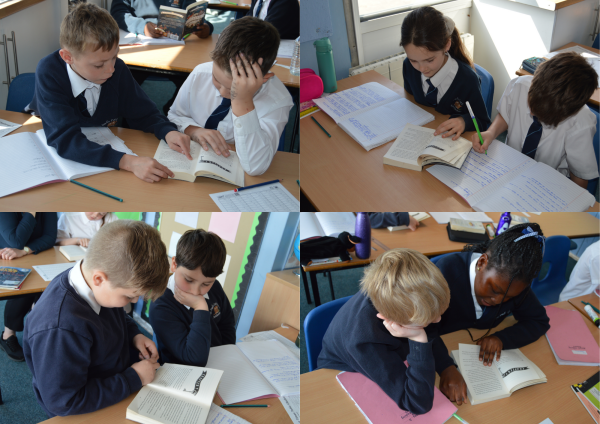
Shared reading session in Year 5
Reading opens doors to new worlds, builds understanding and gives children the confidence to explore ideas far beyond their own experience.
Writing:
• Writing is taught across the school using Writing Roots from Literacy Tree, ensuring a consistent and progressive approach to the teaching of writing.
• Units are carefully designed around high-quality, text-led learning journeys, each with a clear starting point and a purposeful final outcome. This enables pupils to build knowledge, practise key skills and apply them meaningfully within an extended piece of writing.
• Learning is thoughtfully scaffolded to support and challenge all pupils, ensuring that every child can access the curriculum and make progress from their starting points. As a result, pupils are increasingly secure in selecting and applying the appropriate strategies to improve their writing.
• Writing skills are developed progressively so that pupils build the stamina, confidence and independence required to write at the expected standard for their age. Over time, pupils produce writing that is increasingly accurate, coherent and crafted for purpose and audience.
• To support pupils in moving towards independent writing, a wide range of approaches is used, including film and imagery, music, ICT, and modelled, shared and guided writing, alongside purposeful discussion and peer assessment. This ensures pupils develop a clear understanding of the writer’s choices and are able to edit and improve their work effectively.
• Pupils are given varied and engaging opportunities to write for real purposes and audiences, which motivates them to take pride in their work and to see themselves as authors and poets. As a result, pupils write with greater confidence, voice and ambition.
• Opportunities to apply taught writing skills through extended writing are planned across a range of curriculum subjects, enabling pupils to transfer and embed their learning. Consequently, pupils are increasingly able to write fluently and effectively across the curriculum.
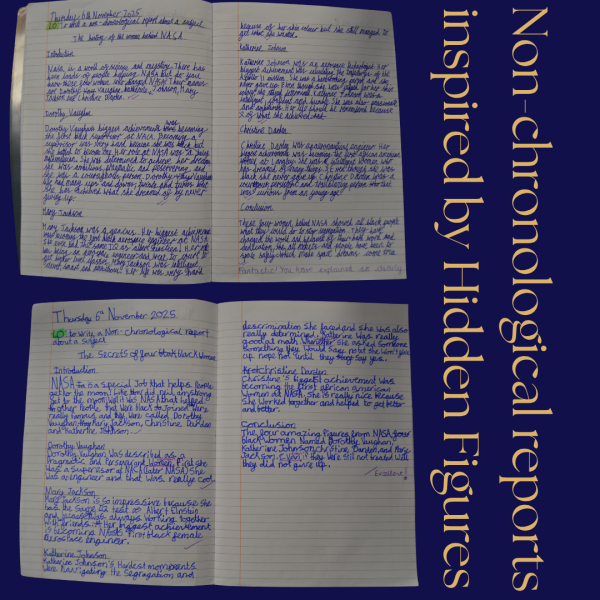
When we teach children to write, we give them a voice — not just for today’s classroom, but for a lifetime of thinking, imagining and being heard.
Spelling:
• In the Early Years Foundation Stage and Key Stage 1, daily phonics sessions are taught using the Twinkl Phonics programme. This systematic and rigorous approach ensures pupils rapidly develop secure early reading skills, enabling them to decode words accurately and confidently.
• In Key Stage 2, spelling is taught explicitly three times a week through Spelling Seeds from Literacy Tree, combined with a structured Sounds and Syllables approach. This supports pupils in developing a secure understanding of spelling patterns, word structure and morphology. As a result, pupils apply spelling strategies with increasing independence and accuracy in their writing across the curriculum.
Handwriting
• In the Early Years Foundation Stage and Key Stage 1, handwriting is taught daily to establish correct letter formation and fine motor control. Cursive handwriting is introduced in Year 2 and is consistently applied across the school, ensuring a clear and progressive approach.
• In Key Stage 2, handwriting sessions take place twice weekly to further develop fluency, consistency and presentation. Where pupils require additional support, targeted interventions are put in place to address individual needs.
• As a result of this structured and consistent approach, pupils develop a neat, fluent and legible handwriting style, enabling them to write with greater confidence, stamina and pride across the curriculum.
Speaking & Listening:
• Pupils are given frequent and purposeful opportunities across the curriculum to develop their speaking and listening skills, ensuring these are an integral part of daily classroom practice. This supports pupils in communicating confidently and effectively in a range of contexts.
• Pupils are explicitly taught and encouraged to ask relevant questions to deepen their understanding and knowledge, articulate and justify their ideas, opinions and arguments, and give well-structured descriptions, explanations and narratives for a range of purposes, including the expression of feelings.
• Through structured discussion and collaborative activities, pupils learn to maintain attention, participate actively, stay on topic and respond thoughtfully to the contributions of others. They develop the ability to initiate and sustain meaningful dialogue, demonstrating respect and active listening.
• Pupils are supported to speak audibly and fluently, with an increasing command of Standard English, and are given regular opportunities to participate in discussions, presentations, performances, role play, improvisation and debate. As a result, pupils grow in confidence and become articulate speakers and attentive listeners, well prepared for the next stage of their education.
Vocabulary:
• Vocabulary development is a key priority at St Paul’s and is explicitly taught and consistently revisited across the curriculum. Pupils are exposed to a rich, ambitious and subject-specific vocabulary in all areas of learning, enabling them to deepen understanding and articulate their thinking with increasing precision.
• Weekly, structured vocabulary sessions are taught across the school, ensuring a systematic approach to the teaching, rehearsal and consolidation of new words. This supports pupils in retaining and confidently using newly acquired vocabulary over time.
• Pupils are explicitly taught a range of effective strategies to independently decode, understand and apply unfamiliar vocabulary. As a result, children increasingly use a widened vocabulary accurately in their speaking and writing, leading to improved comprehension, greater fluency and higher-quality written outcomes.
Vocabulary gives children the tools to turn their thoughts into meaning and their ideas into understanding.
Impact
At St Paul’s, we encourage our pupils to take risks in their reading and writing and to enjoy discussing, exploring and sharing their ideas with confidence. We are ambitious for all children and strive to ensure that attainment is in line with, or exceeds, their potential, taking careful account of pupils’ varied starting points.
Pupils’ progress is closely monitored through a combination of robust daily formative assessment and standardised assessment tools, including NFER assessments, STA assessment guidance and FFT reading tests. These measures enable us to evaluate attainment accurately against age-related expectations and to identify where timely support or challenge is required.
Our English curriculum is carefully designed to ensure that pupils develop the knowledge, skills and confidence they need to succeed academically. As a result, pupils leave St Paul’s well prepared for the next stage of their education and equipped with strong literacy skills that will support them throughout their learning journey and beyond.